Website

How Yoga Is Helping Kids with Cancer

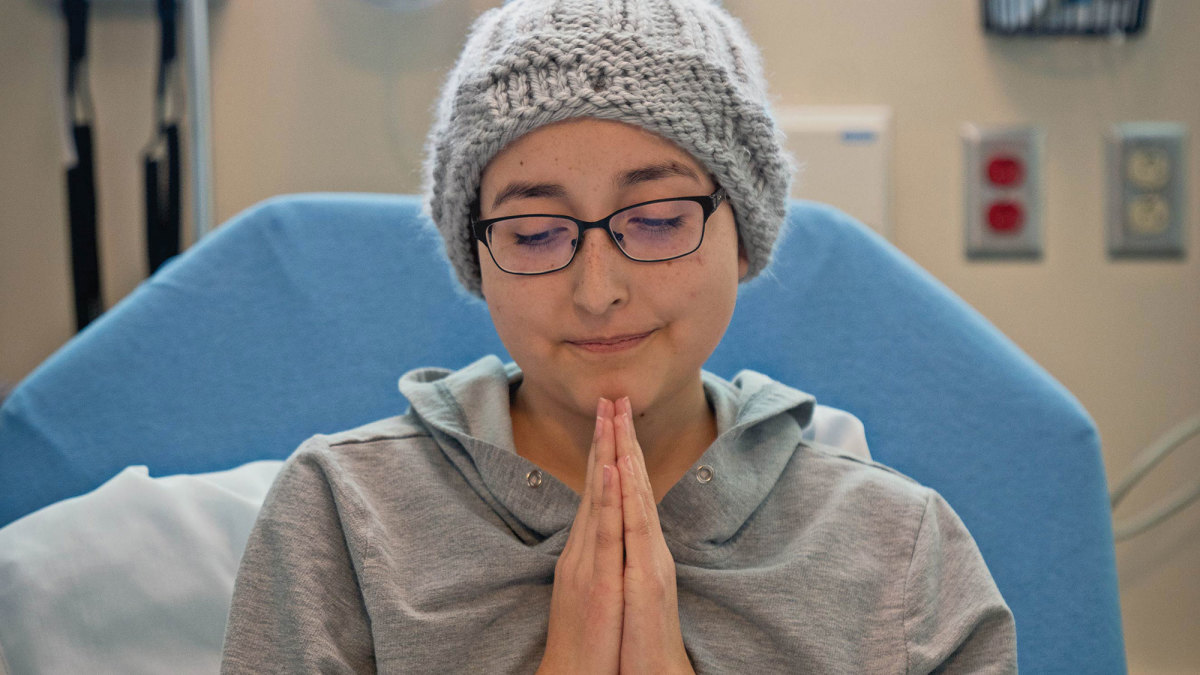
Rady’s Children’s hospital is known for their great oncology Doctors, as well as wonderful yoga instructors. A yoga program for cancer patients and their families is powered by volunteers from the Sean O’Shea Foundation- a non profit organization who’s mission is to empower youth through yoga, mindfulness, and optimistic teachings. The foundation has been running programs for San Diego kids and teens since 2008, and partnered with Rady in 2011 to harness the research-backed benefits of yoga for kids undergoing cancer treatment and their families. Volunteer yoga teachers who are also health care professionals, specialize in yoga for cancer recovery. These volunteers visit the hospital’s oncology unit three days a week, going from bed to bed to offer individualized sessions to whoever’s needs. This can include patients, parents, or friendly visitors. These sessions typically last about 30 minutes and range from pranayama and meditation in bed to asana on colorful mats that are provided by the volunteers.

From this article, I learned that yoga is being used to support patients going through cancer treatment. From breath exercises to yoga poses, each patient may need something different. I learned that yoga can be helpful to anyone at any age and can be used as a coping mechanism for individuals dealing with severe health issues. I found it interesting that yoga is used for the patients and the parents as a stress reliever. I think it is a wonderful program and feel excited to do more research about the benefits of yoga with cancer patients. This article helped answer my content question about the facilitation of yoga and it’s healing benefits.

Tucker, L. (2019, June 26). How Yoga Is Helping Kids with Cancer. Retrieved July 11, 2019, from https://www.yogajournal.com/lifestyle/yoga-is-helping-kids-with-cancer

Blog

Exploring the Yamas & Niyamas: Satya

In Mari’s blog, about Yamas and Niyamas, she addresses a problem that many people in society struggle with, telling the truth. Maris refers to a study done by Bella De Paulo in 1996 where participants kept a journal of any lies that they told each day. The results showed that people lied about one to two times a day. The lies that were recorded were mostly around setting of social interaction with other individuals. She explains that any type of lies is hurtful to ourselves and others and that part of being the best version of ourselves is being truth 100% of the time. 

I learned that Satya is a yoga term that means the practice of truthfulness. I knew that yoga was all about different poses, strength and flexibility, but I did not realize that it also encompasses the practice of truthfulness. I learned that yoga can strip away walls that we put up and help us reveal who we really are and want to be. As I continue to research mindfulness, meditation and yoga, I’m beginning to see them all as connected and realizing that the practice of yoga is much more than stretching on a mat or trying to do a backbend. 

Degener, M. (2015, September 12). Exploring the Yamas & Niyamas: Satya. Retrieved July 7, 2019, from https://www.yogamaris.net/blog/2015/09/12/exploring-the-yamas-niyamas-satya

Book

Book Chapter: Informal, Formal and Intensive Practices

In the chapter, Informal, Formal and Intensive Practices, Ronald Siegel gives a baseline for mindfulness and ways to practice meditation in daily life. Siegel defines mindfulness as more about being and less about doing. He explains that when we are present, many unwanted or unpleasant thought can arise. Most people rather keep themselves busy and push away those thoughts. Siegel explains mindfulness is slowing down, being present and paying attention. “Mindfulness is a dose practice,” says Siegel, meaning that if you do a little meditation you will get a little more mindful. If you do more mediation, you will become much more mindful.

I learned that multi-tasking is actually not as effective as we thinking. According to cognitive science, when we multi-task between two things, each receives 50% of our attention, same if we do 4 things at once, each gets 25% of our attention. I learned that part of mindfulness is single-tasking, meaning only doing one task at a time so you can be intentional and fully present. I also learned that there are ways to practice meditation in all aspects of our life. These are known as informal, formal and intensive meditations. Informal mediations are the idea of being present during every task such as, showering, cooking, driving or brushing our teeth. While we participate in these, usually mindless activities, we can decided to bring our focus to the activity. Showering can be a great informal practice by focusing on the water hitting your body, the warmth on your skin and the relaxed sensation that often comes with showering. Formal meditation practice is when we take time our of the day to just practice our mindfulness through guided meditations or deep breathing. Intensive practice is when we go on a retreat and practice mindfulness in a continuously for many days at a time. This new information helped answer my content questions and gives me more insight around mindfulness and different types of meditations.

Siegel, R. D. (2013). Lecture 3: Informal, Formal and Intensive Practices. In The Science of Mindfulness: A Research-Based Path to Well-Being (The Great Courses). The Teaching Company.

Audio

Podcast: Oprah’s Session with Deepak Chopra: Belief Creates Reality

During Oprah’s interview with Deepak Chopra, he talked about the power of belief. He explained that our mind is so powerful that what we believe becomes our reality. This means that whatever we are thinking will happen, will be what shows up in life because we are looking for it. If we begin to change our belief’s, our life can drastically begin to change in negative or positive ways. Deepak speaks about how, as we begin to grow up, we begin to think of ourselves as separate from ourselves. This divide makes us become imprisoned from our beliefs and stops us from becoming our true selves.

I learned that if we can see everything around us as merely arising and subsiding and not react, we can begin to enjoy the roller coaster of life. I also learned that a way to check if you are being present in the moment is by saying to yourself, “Are you aware?”. This is a great self check-in to help you be mindful in moments when things are stressful or overwhelming. This podcast helped answer my question around what mindfulness is by Chopra explanation of mindfulness.

Deepak Chopra Session: Belief Created Reality- Oprah’s Super Soul Sunday [Audio blog interview]. (2019, June 25). Retrieved July 6, 2019.

Creative Work

Documentary: Heal

Heal is a documentary that tells the “why” behind mindfulness, meditation and the power of positive thinking. Heal tells the story of many individual’s that have experienced life threatening trauma or chronic health problems. The film also features the science behind the impact of our thoughts on our bodies. Many Doctors, biologist, and physicist were interviewed in the film from Deepak Chopra to Micheal Beckwith. Many of the ideas expressed in the film are profound because of their ideals, as well as the science that actually proves their ideas. 

I learned from the film that the emotional trauma that individuals harbor actually effects their overall health. Someone may be a kind, easy going individual that is liked by many, but if that individual does love themselves, it doesn’t matter. I did not know that there is proven science behind the health benefits of meditation. Meditation puts people in a state of relaxation, also know as when the parasympathetic nervous system is engaged. This is a state of rest where the body conserves energy and “good” chemicals are released such as dopamine, serotonin, oxytocin and endorphins. I also learned that the practice of gratitude is incredible power and can actually alter the chemistry in our bodies. When we receive something and practice thanks, our body releases chemicals that support healing and relaxation in the body. When we practice gratitude, our body thinks we are receiving something and release those healing chemicals in our body. It is as if we are tricking our body into pumping out “good chemicals”. Just the simple act of gratitude can help strengthen our immune system, support healing in the body and act as a preventative to developing chronic diseases. 

These natural healing qualities in the body are supported through the facilitation of mindfulness, meditation and yoga. This filmed helped educate me around the deeper meaning of mindfulness and why it is so important to our overall health. I also learned that when we practice gratitude there are chemicals that are released into our bodies that support our immune system, heal our body, and make us feel happy. All of my content questions were answered through this film and have helped me understand the power of the mind. 

Noonan, K. (Director). (2017). Heal [Motion picture]. United States: Paladin.

Experiential

Maris Degener

You have to be willing to do the work.”

Maris Degener is a college student at UC Santa Cruz, a local yoga teacher at Just Be Yoga and a survivor of perfectionism. Maris struggled with an eating disorder at age 14 and was able to used yoga as her means of physical, mental and emotional healing. Her story is beautifully told in a Netflix documentary titled, I Am Maris.

Maris originally took a yoga class because it was the only form of exercise that her Dr. would approve in her condition. Her initial intention for the class was just to burn calories and sweat. After one class at Just Be Yoga, she realized yoga was much more than she had initially though. She was drawn to a sense of freedom that she had experienced and let herself be intrigued by her curiosity. Shortly after practicing yoga for a new months, Maris was accepted into Just Be Yoga’s teaching training program as the youngest teacher in training.

During the teacher training, Maris learning about the eight limbs of yoga and each of their deeper meanings. It was during her teacher training that she learned about Ahisma, meaning non-violence. She thought to herself, “duh, it isn’t okay to go around kicking and punching people.” Quickly, she realized that this yoga principle also applied to the self. She realized that she was being extremely violence towards herself through her need for perfectionism and control. It was this principle of yoga that helped Maris understand how to heal and become willing to do the work that it required.

In my interview with Maris, I learned that what people generally think of as “yoga” is much different from what yoga actually is. The physical poses in yoga, know as asanas , are actually only one aspect of yoga. There are eight limbs of yoga that address ideals, from your everyday breathing to your moral and ethical actions daily. In the interview with Maris, I felt as though my content questions were answered fully. I asked Maris what she thought the most important aspect of yoga is, that individuals staring yoga should focus on first. “The really key is mindfulness” was her response. She expressed that you must be able to observe what is happening within, with non-judgement and learn to separate your emotions from yourself. She described this as, “imagining your thoughts as moving cars on a freeway.” It wouldn’t be productive to go run in front of all the cars and try to stop or change them, instead just observe them driving by. Maris also explained that yoga and meditation go hand and hand. Usually classes facilitate mediation at the end of a yoga class when the body has moved through many poses. The reason for this is so that individuals are able to workout any pend up energy, so that once it is time to meditation, it is actually possible. Mindfulness and meditation are aspect of the eight limbs of yoga, so essentially, you can’t have one without the other.

Degener: Degener, M. (2019, July, 5). Maris Degener: Yoga teacher at Just Be Yoga[Personal interview].

Experiential

Chris Walsh: Campolindo Yoga Teacher

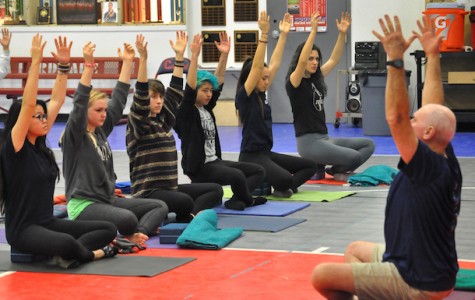
Chris Walsh is a beloved member of the Moraga community and has brought yoga to Campolindo High School for the first time ever. Chris was an elite runner who build his life around being able to run competitively . After many years of wear and tear on his body, Chris knew he needed to change up his workout for the longevity of his body. Chris tried his first yoga class with a male instructor who he said, “looked like a body builder”. He was intrigued by the vibe of the class and loved the sound of the sanskrit language that is commonly used in yoga classes. He felt that the class was similar to a moving meditation which was similar to his long runs in the woods. Then, “the stars aligned” as Chris says when the weight lifting elective at Campo began to drop in enrollment. One of the counselors that knew Chris was beginning to become a yogi, suggested that they change the class to a yoga class. So naturally Chris said, “sure!”. Since the training was expensive and the parents wanted it, Chris was able to get the help and support of the community to send him to a 200-hour summer intensive. Since then, he has been teaching yoga at Campolindo for the last 3 years and is diligent on continuing to grow the program. 

Through my interview with Chris, I was able to learn that everything in life happens for a reason and if you stay open to possibility, life will give you what you need. This aligns with the ideals of mindfulness that when we are open to change and possibility, our reactions can be neutral. Learning to not see things in life as black or white, or good or bad is part of being mindful. I learning that practicing yoga and mindfulness, is not something that we do during set aside times in the day, but that it’s a continual practice that slowly becomes weaved into all of our interactions in life. My conversations with Chris helped answer my content questions about what mindfulness is and how yoga individuals mental and emotionally deal with the uncertainty of life. 

Walsh: Walsh, C. (2019, June 14). Yoga at Campolindo [Personal interview].

Artifact

Tibetan Singing Bowl

Tibetan singing bowls have been used for centuries for healing and meditation practices in Eastern cultures. Our bodies have natural vibrations that can become out of sync or unaligned with our bodies when we become chronically stressed or in deep physical pain. Tibetan Singing Bowls are thought of as a type of “sound medicine” that can help with stress disorders, physical pain, anxiety, and depression. The way that the healing vibrations work are through entraining our brain waves to sync with the sound of the bowls. The vibrations from the bow can also be used to create a great environment for deep meditation, innovative thinking, and deep questioning. 

Through experiment with my own Tibetan singing bowl, I noticed that the sound can be very calming and soothing for my body if I’m feeling stressed or anxious. I had no idea that tibetan singing bowls have been used with patients receiving cancer treatment. I learned that disease is thought of in some cultures as the body or a specific organ being unharmonious or “out of tune” with the body. It is thought that using the sound waves from a tibetan singing bowl can re-sync the body. Through learning about the purpose and uses of the Tibetan singing bowl, I am able to answer one aspect of my content question regarding yoga as a means to physical healing.

Faubion, Jenna. (2019, June 27). Tibetan Singing Bowl [Brushed Brass Bowl] Personal Item, Walnut Creek, California. 

Book

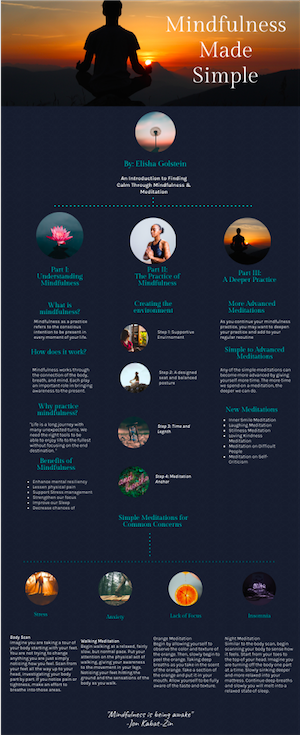
Mindfulness Made Simple

Mindfulness can help us begin to recognize the patterns of the mind that have developed beyond our customary consciousness, and respond to life in new ways rather than old habits.”

In Dr. Elisha Goldstein’s book, Mindfulness Made Simple, Goldstein breaks down the craze around mindfulness and why it has become so popular in the last few years. Mindfulness Made Simple is broken down into three sections; understanding mindfulness, the practice of mindfulness and a deeper practice. Throughout the book, Goldstein gives many real-life examples, practical meditation exercises and the “why” behind mindfulness and meditation. 

I learned that meditation practice is used in many competitive sports, such as football, to help players become calm and focused before a game. I also learned that the first type of meditation that Goldstein suggests is a body scan. This is a meditation that helps connect the body and mind through awareness. Goldstein says, that this is the first step towards mindfulness and connecting the body, mind and spirit to the present. This book helped answer my content question because it broke down what meditation and mindfulness are and the best the best ways to begin your practice. 

Book: Goldstein, E. (2014). Mindfulness made simple an introduction to finding calm through mindfulness & meditation. Berkeley, CA: Calistoga Press.